
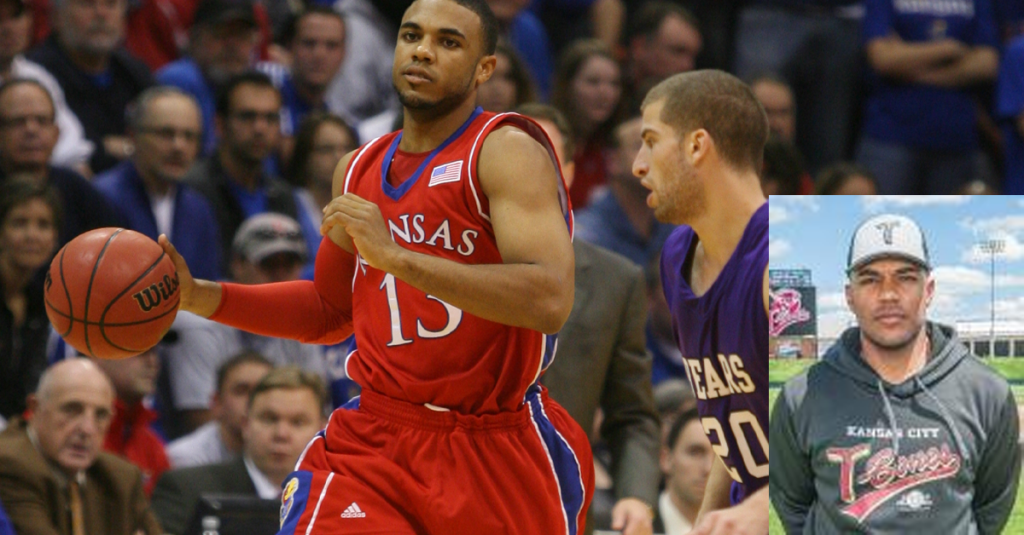
In the month of March, much of the country’s sports bandwidth is devoted to the NCAA Division I Men’s Basketball Tournament, which culminates in the Final Four this weekend. The Madness leads to many memorable storylines and sometimes future baseball stars play a part: Kenny Lofton and Tony Clark both played hoops at Arizona before moving on to long MLB careers and Randy Winn teamed up with Basketball Hall of Famer Steve Nash at Santa Clara for a legendary upset in the 1992 tournament.
The inbounder for Valparaiso’s famous “Pacer” play that earned them a legendary first-round upset in 1998? Arizona Diamondbacks minor-leaguer Jamie Sykes (who didn’t make it to the majors).
The Venn Diagrams will sometimes brush against each other, but when it comes to the American Association, that’s not the case, except for one exception (that we know of): C.J. Henry, a dual-sport athlete who accomplished the feat of playing in the Big Dance and the AA.
A baseball beginning
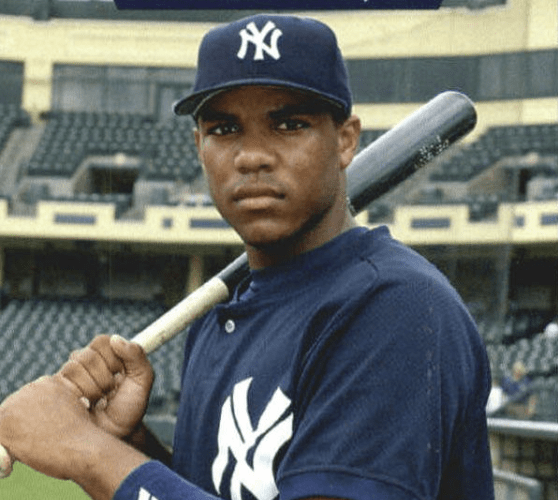
Henry came from a basketball family: his father Carl starred at the University of Kansas and played briefly in the NBA during the mid-80’s. C.J. also was a gifted hooper growing up just outside of Oklahoma City, committing to Kansas out of high school, with North Carolina and Texas among other big-time basketball programs in pursuit of him.
However, Henry’s baseball skills caught the attention of the New York Yankees, who selected him 17th overall in the 2005 MLB Draft and forked over $1.575 million to forgo college and play baseball. (Of note: the late longtime American Association pitcher Tyler Herron was also selected in the 2005 first round, by St. Louis)
Playing exclusively at shortstop at the onset, Henry’s defense struggled, while he showed glimpses of his athleticism offensively, slashing .249/.333/.381 with 12 extra base hits and 17 stolen bases in 48 games over his first pro season at rookie ball. Midway through his first full season, on July 30, 2006, he was part of a blockbuster six-player deal that sent veterans Bobby Abreu and Cory Lidle to the Yankees, while Henry was one of four minor leaguers sent to Philadelphia in return.
In the Phillies organization, Henry’s numbers were mostly the same at Low-A through the remainder of 2006, finishing the season with a .692 OPS, 32 extra-base hits, and 15 steals over 102 games of full-season ball. However, a repeat of Low-A in 2007 was a disaster, as he hit just .182 over another 102 games, and the Phillies released him. The Yankees re-signed Henry in 2008, but after just 20 games at High-A, he left baseball behind to return to the court.
Hoop Dreams Renewed
Despite four years removed from the hardwood, Memphis head coach John Calipari was willing to bring in Henry to play big-time basketball. A big reason why? C.J.’s younger brother Xavier was one of the top recruits in in the Class of ’09 and Calipari was more than happy to welcome C.J. into the fold to woo his talented brother to Memphis. Indeed, the ploy worked and Xavier cited the chance to play with his brother as a key reason in choosing the Tigers.
However, in March of ’09, Calipari moved on to Kentucky and the Henrys re-evaluated their options, with the pair landing back where C.J. Henry committed four years prior: at Kansas under Bill Self.
Both Henrys spent only one year in Lawrence, with mixed results. Xavier started all 36 games, averaging 13.4 points per game, then declaring for the NBA Draft, where he was selected 12th overall by the Memphis Grizzilies. C.J., meanwhile, looked the part of someone who hadn’t played competitive basketball in four years. After beginning the year seeing decent minutes off the bench, his playing time dried up and despite playing on one of the top teams in the country, Henry played only three game in Big 12 play and didn’t score a point after January 2.
The Jayhawks, meanwhile, saw their season come to a shocking end in the 2010 NCAA Tournament, when Northern Iowa took out Kansas in the second round (say the name “Ali Farokhamesh” in Lawrence, then duck). C.J. Henry didn’t play in the UNI loss, though he did see brief mop-up action in KU’s first-round win over Lehigh, getting one small glimmer of March action.
With his brother off to the NBA and little prospect for improved minutes, C.J. also left Kansas after a year and returned to his home state of Oklahoma, playing one year of college hoops at NAIA Southern Nazarene before leaving the hardwood after the 2010-11 season.
Back to the Bases
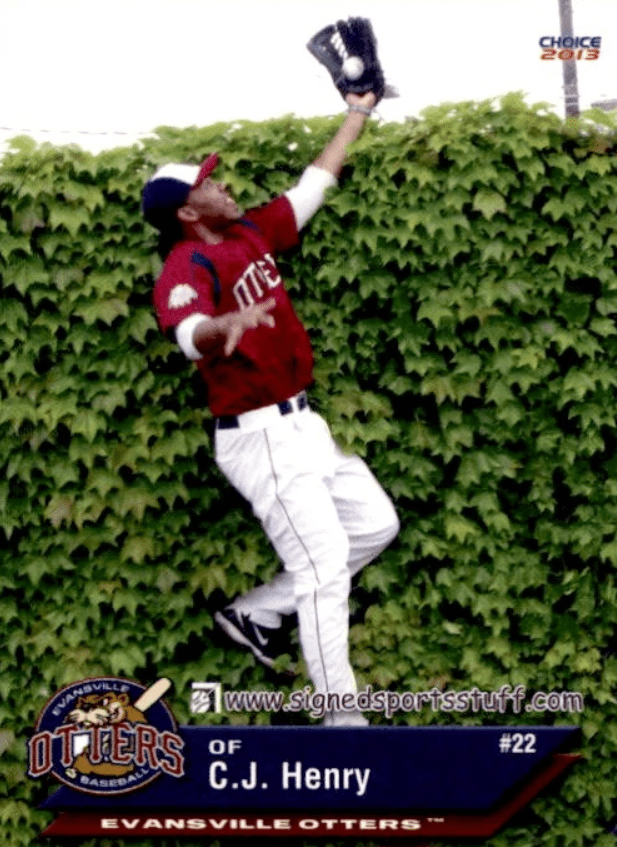
Henry was out of the limelight for much of the next two years, but somewhere along the way, he decided to give baseball another try. Five years after his last game on the diamond, at 27 years old, Henry signed with the Frontier League’s Evansville Otters and put together far and away the best year of his career, slashing .332/.410/.523 with 26 extra base hits in 57 games and playing in the FL All-Star Game.
He did not play in 2014, though, which brought him back to Kansas in 2015. Just 35 minutes from Allen Fieldhouse, where he played college basketball five years earlier, Henry was signed by the Kansas City T-Bones. This time, Henry went just 6-for-41 with two RBI in 13 games and was released less than a month into the season.
Similar to his foray into March, C.J. Henry’s stint in the American Association was brief, perhaps being illustrated by the fact that I could not find any shots of him as a T-Bone (just a grainy Pointstreak headshot) or in the NCAA Tournament.
Nonetheless, while Henry’s athletic career never fulfilled the expectations by his basketball recruiting ranking or his lofty draft status in baseball, he does hold the unusual footnote as the one on-field crossover between the American Association and the beloved NCAA Tournament.
—
Thanks for reading! Please give me a follow on Twitter/X at @AABaseballFan1 and Instagram at @aabaseballfan
 AABaseballFan.com
Leave a comment