To be clear, there is still no official announcement, but enough reliable people have told me that it’s happening: the American Association is losing two teams in 2027 and one of them just played their final game in the AA last night: the Cleburne Railroaders.
On Saturday night, they were officially bounced from the American Association playoffs with a whimper, being blanked 4-0 in a decisive Game 3 in Milwaukee, without even so much as a home playoff game after they elected to forgo a first round trip back to Cleburne and instead play the whole series on the road.
We are less than a month away from the ten-year anniversary of the Railroaders’ officially joining the AA and just weeks away (if that) from the official word that they’ll be a part of the Frontier League/National Association in 2027. In between, it’s been an unsteady ride.
A Name Fitting of the Idea
The 19th and early 20th century railroad industry in many ways was surprisingly similar to the modern independent baseball sphere: some schemes were well thought-out, well-funded, built out responsibly, and perhaps had favorable geography and demographics to further fuel success.
Once it was proved that there was money to be made, many others rushed in with grand plans and wild dreams of their own, but were either poorly conceived, poorly funded, overextended, oversaturated a certain area, or just simply didn’t have enough paying customers to make it work.
In a way, that’s an apt way to look at the Cleburne Railroaders.
When the team was officially founded in the fall of 2016, their main objective was to replace the Joplin Blasters, who had just finished crashing and burning through a two-year existence. But the team also was meant to solidify a Texas core that was crumbling: El Paso had been snapped up by affiliated baseball after the 2013 season, Amarillo had just folded, while Laredo and Texas (Grand Prairie) were still around, but neither was doing well.
Fort Worth had been a successful market in the AA’s early days, but the 2009-10 recession crippled that franchise to a state they never recovered from and they left the AA in 2011, then folded in ’14.
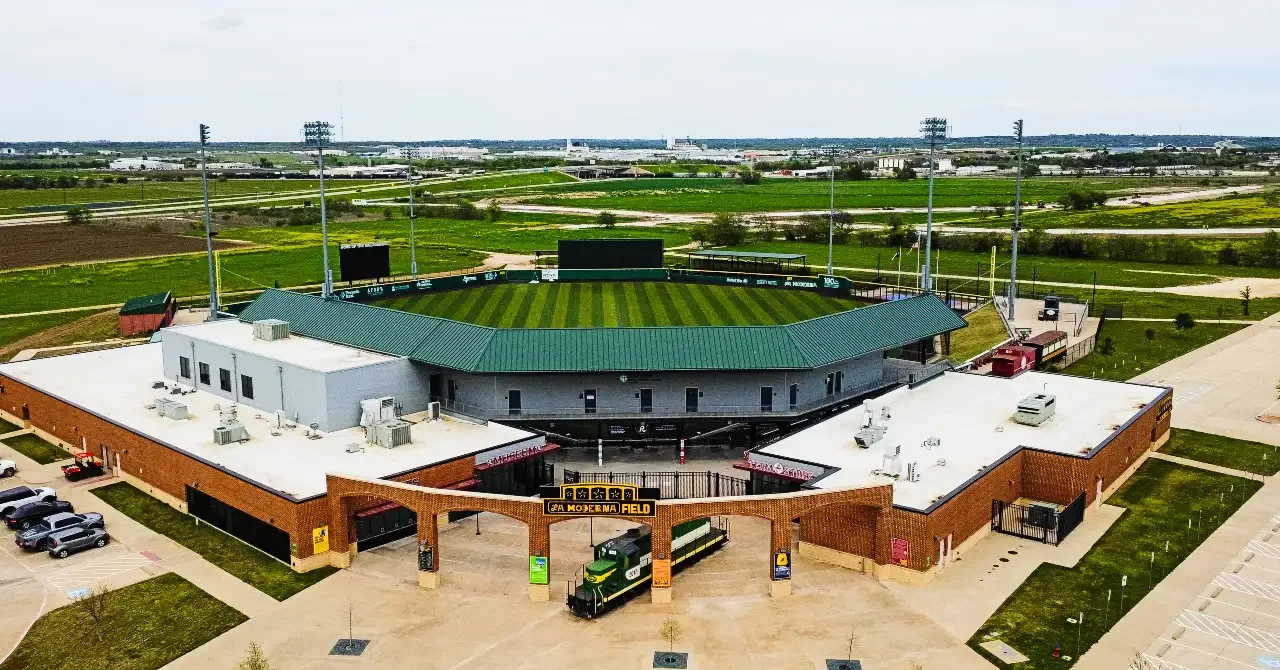
Maybe bringing the Fort Worth market back wasn’t the entire idea, but make no mistake, Cleburne is located just close enough to Cowtown and its southern suburbs that they were counting on some of those folks to trek down the Chisholm Trail Parkway and fill a ballpark that was being built in a town of just 30,000 people.

Dreams Dashed by Reality
The first year wasn’t all that bad. The team went 47-53 and drew over 103,000 fans in 2017—both numbers that provided hope going forward. Alas they were propped up by the travel team (Salina), which provided them 13 wins, plus ten extra home games for a league-record 60 home dates.
In 2018, with the league at 12 permanent teams once again, even the presence of 53-year-old MLB legend Rafael Palmeiro (and his .301/.424/.495 line with six homers in 31 games) wasn’t enough to to prevent a 33-66 finish or per-game attendance from cratering by nearly 30 percent.
The arrival of several Wichita Wingnuts players, coaches, and executives breathed life into the on-field side in 2019, nearly leading to a playoff berth that year and eventually five playoff trips in six years beginning in 2021, highlighted by 60 wins and a division title in 2024. Players like Chase Simpson and Zach Nehrir became stars, eventually had their numbers retired, and led fun, exciting offensive squads.
But in the world of independent baseball, it doesn’t matter much if the financials don’t work and here they just never quite did. Laredo folded two weeks before the Railroaders’ inaugural game. Texas limped through three more seasons then went belly-up in the fall of 2020. When the dust settled post-COVID, the Railroaders were all alone: two full states, eight hours, and over 500 miles away from their nearest rival, Kansas City. That’s the way it remained for the past six years.
Down in Texas, not enough people came out. The ballpark was supposed to spur development nearby (a nearby apartment complex finally went up in the last couple years), but that’s been limited to a couple gas stations, a Kubota heavy equipment dealer, and acres of empty fields on the edge of town (which fireworks caught on fire at least once).
Announced attendance perked up somewhat in recent years, but those numbers never topped 1,700 per night and even then, a closer look at weeknight attendance numbers (a lot of nights announced at barely over 1,000) hint that even those numbers were probably inflated to some degree. This year, seemingly with more honest reporting, total attendance fell to under 48,000, numbers not seen in the AA in a decade.
Meanwhile, the team was sold in 2018, more partners were brought on in 2021, and the club was sold again in ’23. Two rebrands also took place in efforts to freshen things up. Still, marooned on the North Texas island, it was not nearly enough.

A New Path Forward
Personally, the Texas Collegiate League always seemed like a more reasonable path forward. That circuit is confined to Texas and Louisiana, the season is shorter (no school nights), and the club isn’t paying their players. Alas, the Frontier League (which will be renamed the National Association next season) is the choice.
There is some logic there. The FL/NA has Mississippi a reasonable bus ride away. Player salaries are also lower. But professional baseball is still expensive, and the sprawling nature of that league will still mean a lot of flights to Chicago (and St. Louis, Cleveland, Cincinnati, etc.).
A lot of fundamental issues that plague the franchise (Texas heat, small market, challenging cooperate base, geography, etc.) will not be solved by changing leagues and it’s absolutely fair to question the franchise’s long term viability. But that’s the Frontier’s problem now.
In the meantime, a long-term headache for the American Association finally is resolved and a chapter closes. After starting with three Texas teams in 2006 (and having as many as four in the early 2010’s), the AA will not field a team in Texas—or anywhere in the southern half of the U.S.—for the first time in league history once 2027 rolls around. They may never do so again.
It’s ironic in a way: the Northern League originally split in the fall of 2005 and the AA was formed in large part because of disagreements between clubs on whether to entrench their Upper Midwest footprint or try to push for something bigger and bolder. Yet, the end result is that two decades later, the AA footprint will almost perfectly mirror that of the 2004 Northern League, but that’s a conversation for another day.
On this particular day, the last train has left the Lone Star State.
—
Thanks for reading! Please give me a follow on Twitter/X at @AABaseballFan1 and Instagram at @aabaseballfan
Leave a Reply